Aga Khan University Hospital Puts Kenya at Forefront of East Africa’s Robotic Surgery Revolution
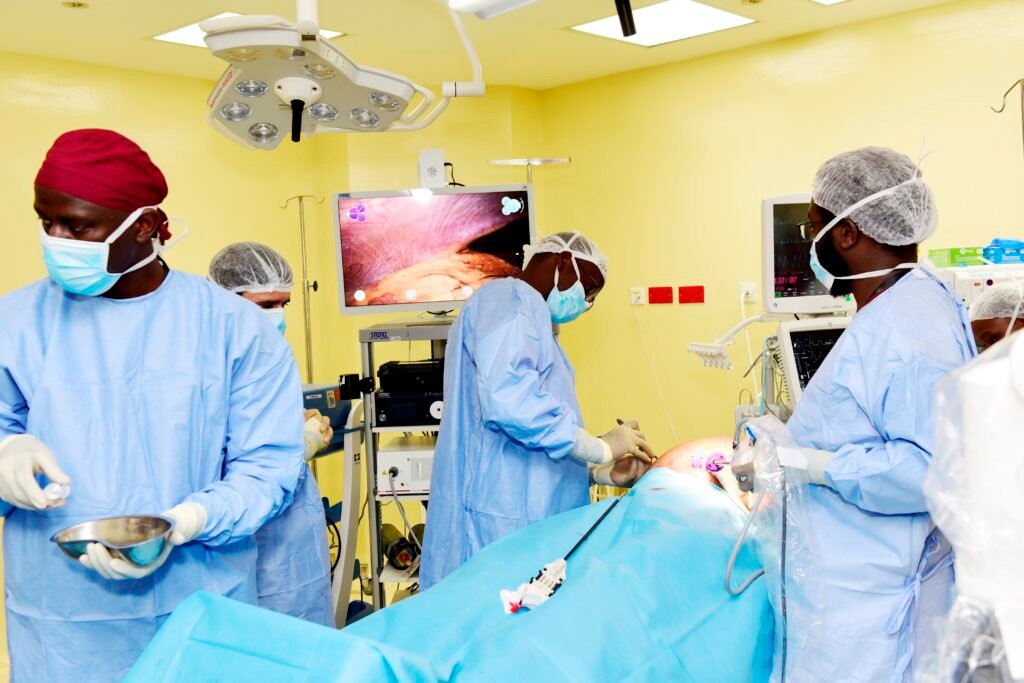
Kenya is steadily emerging as a regional hub for advanced medical care as Aga Khan University Hospital, Nairobi (AKUH,N) expands the use of robotic-assisted surgery, opening a new chapter in how complex procedures are performed in East Africa.
The latest milestone came on August 19, 2026, when the hospital performed what it described as East Africa’s first robotic-assisted gallbladder removal surgery, demonstrating how technology is moving beyond highly specialised operations into established general surgical procedures.
The development is significant for a region that has historically struggled not only with access to surgery but also with shortages of specialist medical personnel.
Robotic-assisted surgery does not mean that a robot independently operates on a patient. Instead, the surgeon remains in control throughout the procedure while using a robotic system that provides enhanced visualisation, precision and movement.
The technology gives surgeons a three-dimensional view of the operating area and instruments capable of a greater range of movement than conventional laparoscopic equipment. This can be particularly valuable when operating in confined or difficult-to-reach areas of the body.
A New Chapter for Surgery in East Africa
For years, the major conversation around surgery in East Africa has centred on increasing the number of people who can access safe operations.
That challenge remains.
The Lancet Commission on Global Surgery established a benchmark of about 5,000 surgical procedures per 100,000 people annually, but historical assessments have placed Eastern sub-Saharan Africa well below that target.
The emergence of robotic surgery therefore represents another dimension of the region’s healthcare development: improving not only the availability of surgery but also its sophistication.
Kenya has increasingly attracted patients from neighbouring countries seeking specialist treatment, strengthening Nairobi’s position as a regional medical referral centre.
However, the country’s specialist workforce remains a major challenge. Previous estimates have put Kenya’s number of surgeons, anaesthetists and obstetricians at about 2.35 per 100,000 people, against the recommended benchmark of 20 per 100,000.
Robotics cannot solve that shortage.
What it can potentially do is provide existing specialists with better tools to perform difficult procedures with greater precision and control.
Why the Gallbladder Operation Matters
Gallbladder removal is one of the clearest examples of how robotic technology could become part of mainstream surgical care.
Known medically as a cholecystectomy, the operation can be performed through traditional open surgery or minimally invasive laparoscopic techniques.
The robotic-assisted procedure builds on keyhole surgery by giving the surgeon enhanced visualisation and greater freedom of movement while working through small incisions.
That distinction matters because the August 19 procedure at Aga Khan University Hospital was not simply a demonstration of futuristic technology. It involved applying robotics to a well-established general surgical operation.
For patients, the important question is ultimately not how sophisticated the equipment looks but whether it contributes to safer procedures and better recovery.
Minimally invasive surgery is associated with benefits that can include smaller incisions, reduced post-operative pain, shorter hospital stays and faster recovery compared with open surgery.
Robotic assistance seeks to preserve those advantages while improving the surgeon’s control during technically demanding procedures.
Robotics Moving Beyond One Specialty
The potential use of robotic-assisted surgery also extends well beyond gallbladder operations.
At Aga Khan University Hospital, the technology is being developed across several areas, including urology and prostate surgery, pelvic procedures, gynaecology, paediatric surgery and orthopaedics.
That range suggests robotic technology could increasingly function as a common surgical platform serving different medical specialties rather than remaining restricted to a small number of procedures.
For Kenya, the implications could be considerable.
Expanding advanced surgical capabilities locally could reduce the need for some patients to travel outside the region for specialised procedures while potentially attracting more patients from neighbouring countries.
It could also provide opportunities for Kenyan and regional specialists to develop expertise in advanced minimally invasive surgical techniques.
Technology Won’t Replace Surgeons
Despite the term “robotic surgery”, the technology is not designed to remove the doctor from the operating theatre.
The surgeon controls the robotic instruments and makes the clinical decisions throughout the procedure.
Its value lies in extending human capability.
Greater visual clarity can help surgeons identify structures more accurately, while highly flexible instruments can assist with precise movements and delicate tasks such as stitching in confined spaces.
The technology could therefore prove particularly useful in procedures where access and precision are critical.
But its success will depend heavily on the people operating it.
Hospitals adopting robotic systems must invest not only in equipment but also in training surgeons, anaesthetists, theatre nurses and technical teams capable of supporting the technology.
Cost and Access Remain Major Questions
The arrival of robotic surgery also raises an important question for East Africa: who will be able to access it?
Historical estimates have indicated that more than 95 per cent of people in Eastern sub-Saharan Africa lacked access to surgical care that simultaneously met standards of safety, timeliness and affordability.
Robotic systems require considerable investment in equipment, maintenance, infrastructure and specialist training.
Hospitals will consequently face the challenge of ensuring technological advancement does not create an even wider divide between patients able to afford sophisticated treatment and those still struggling to access basic surgery.
The long-term success of robotics in East Africa may therefore depend as much on financing and training models as on the machines themselves.
If hospitals can increase the number of specialists trained to use the technology, spread its application across different procedures and develop sustainable ways of financing treatment, robotic-assisted surgery could become an increasingly important part of the region’s healthcare system.
For now, Aga Khan University Hospital’s robotic-assisted gallbladder operation provides a glimpse of that future.
It signals a shift in East African healthcare from a conversation centred almost entirely on expanding surgical access towards one that increasingly includes precision, minimally invasive treatment and advanced medical technology.
The robot may attract the attention, but the bigger transformation is what it allows surgeons to do: operate with greater visibility, movement and precision while bringing increasingly sophisticated treatment closer to patients in the region.